
Picture this: a team spends three months building a gambling review site. The content is solid, the design is clean, and the reviews are genuinely researched. Launch day comes. Traffic is basically zero. A handful of visits from friends and family, maybe a bot crawl or two. It’s a common and deflating experience in this niche, and it has nothing to do with effort.
Gambling review sites face a particular combination of obstacles. Search engines are cautious about this category. Readers are skeptical, especially after encountering hundreds of sites that exist purely to push affiliate clicks. Regulators in the UK, Australia, Canada, and across Europe have tightened rules around advertising and endorsement language, which means the gap between what you want to say and what you’re legally allowed to say can be significant. Rules vary by country and region, so always consult qualified compliance guidance before publishing claims about bonuses, licensing, or player protections.
The sites that actually grow in this space share a few things in common: they’re useful before they’re commercial, they’re consistent without being robotic, and they’ve earned enough credibility that readers come back and share them. That’s the core idea here. There are no traffic shortcuts that survive long-term in a niche this competitive and this regulated.
Most players don’t land on a review site with full trust intact. They’ve already visited two or three other sources, cross-checked a bonus claim, and maybe Googled the casino name directly. Sites like jackpot-jill.com get reviewed and discussed across forums and comparison pages precisely because users want multiple perspectives before committing real money. Your job as a review publisher is to be one of those credible perspectives — not to funnel people as fast as possible, but to genuinely help them decide.
That shift in mindset — from traffic machine to trusted resource — is what separates review sites that plateau after six months from the ones that compound steadily over two or three years. The strategies below reflect that approach. They’re practical, not idealistic, and they apply whether you’re a solo writer or a small editorial team.
Start With Positioning
Before writing a single review or optimizing a single page, be specific about who you’re writing for. “Casino reviews for everyone” is a position that works for no one. The sites that gain traction faster are the ones that mean something to a defined reader: beginners navigating their first deposit, bonus hunters who want terms spelled out clearly, mobile-first players in specific markets, or people looking for low-minimum casinos in a particular country.
Positioning shapes everything downstream — your keyword targets, your review criteria, your email content, even your visual design. A site for Australian players covering fast-withdrawal casinos will write, rank, and convert very differently than a site reviewing high-roller VIP programs. Vague positioning forces you to compete with enormous, well-funded portals on their own terms. A specific angle lets you win in corners the big sites don’t bother with.
Build a Review Framework Readers Trust
Readers can tell the difference between a review written from experience and a review assembled from a casino’s own press materials. The most common failure mode in this niche is thin reviews that repackage operator-supplied information without any editorial judgment. Building a transparent, consistent framework is both an ethical obligation and a competitive advantage.

A solid review framework covers the things players actually care about — and explains why each criterion matters, not just whether the casino passes or fails. Here’s a baseline checklist that works for most audiences:
- Licensing authority and jurisdiction (e.g., MGA, UKGC, Curaçao) and what those mean for players
- Withdrawal speed: tested averages, not operator claims
- Available payment methods and any fees or limits
- Bonus terms: wagering requirements, eligible games, expiry windows
- Mobile usability: browser-based and app experience
- Customer support: channels available, response speed, and quality
- Game library: provider diversity and whether popular titles are actually available
- Responsible gambling tools: deposit limits, self-exclusion, reality checks
- Any red flags: unresolved player complaints, slow payouts, vague T&Cs
Publishing this framework publicly — on a “how we review” methodology page — adds a layer of accountability most competitors skip. When readers can see exactly how you scored a casino, they trust the score more. That trust is a real growth asset.
SEO Structure That Scales
Most gambling review sites treat SEO as keyword placement rather than architecture. That’s backwards. The sites that rank well over time are built around topic clusters: a hub page that covers a broad subject (say, “online casinos in Canada”) supported by deeper content covering specific aspects (payment methods, licensing, provincial rules, game types). Every piece links to the hub, and the hub links back. Search engines read this structure as authority; readers use it to navigate naturally.
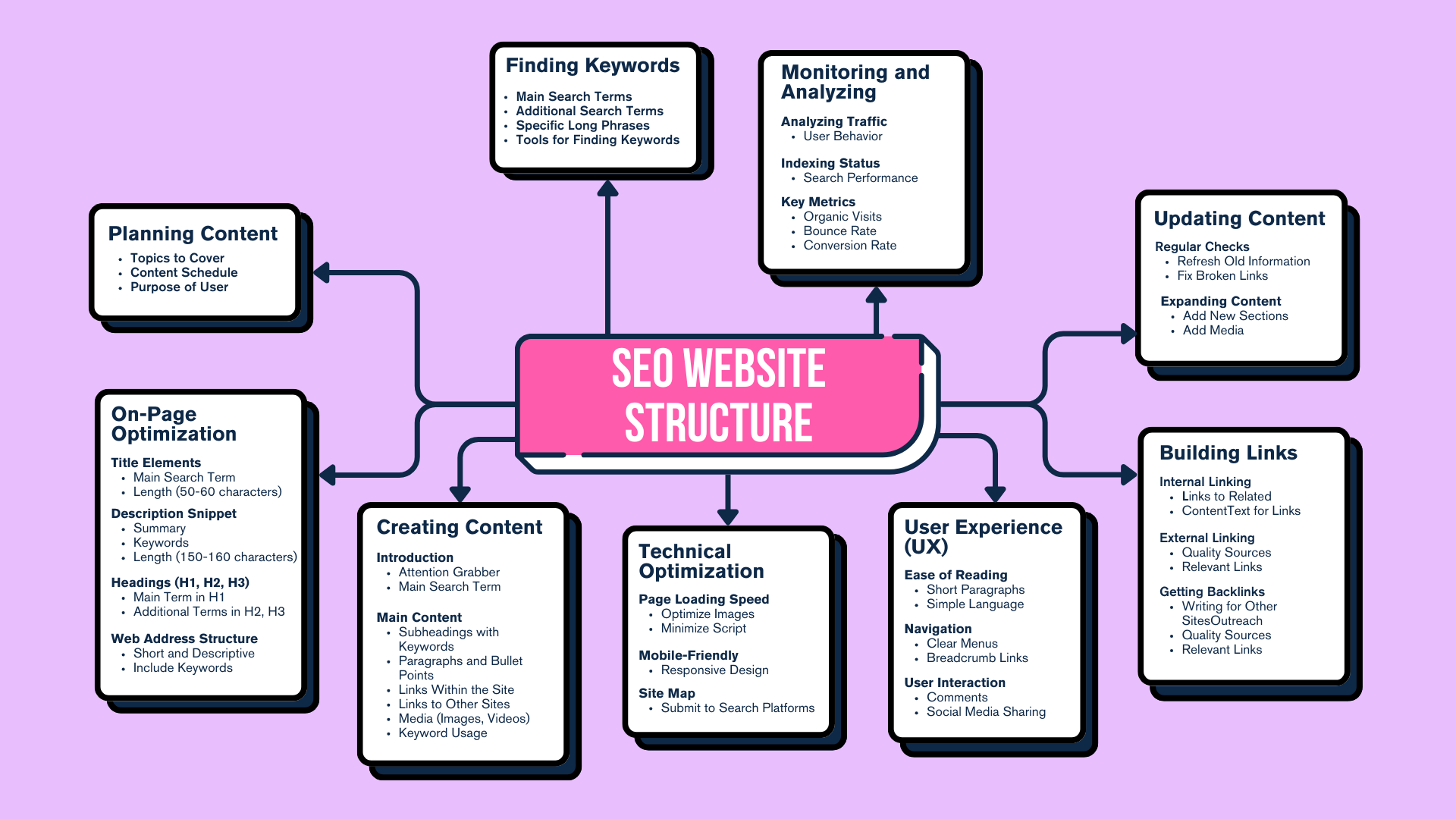
Internal linking is the most underused tool in this niche. Review pages should link to relevant comparison pages. Guides should point to specific reviews. FAQs should feed into both. This isn’t about stuffing links — it’s about building a coherent site that treats related content as connected rather than isolated.
| Page Type | Search Intent | What to Include | Common Mistake |
|---|---|---|---|
| Casino Review | Navigational / commercial | Scored criteria, pros/cons, tested data, update date | Copying operator descriptions |
| Comparison Page | Commercial / decision | Side-by-side table, clear winner logic, honest caveats | Listing everything as “top-rated” |
| Guide / Explainer | Informational | Definitions, step-by-step process, real examples | Too generic, no original angle |
| FAQ Page | Informational / featured snippet | Concise direct answers, linked to deeper content | Padding with irrelevant questions |
Content That Wins Before Conversion
Informational content is the unglamorous workhorse of a well-ranked review site. Pages explaining how wagering requirements work, what a gaming license actually means for a player, how crypto deposits compare to bank transfers, or which payment methods work in specific countries — these don’t convert immediately, but they build the audience that eventually uses your commercial pages.
Country-specific explainers are particularly valuable because they’re often underserved. A well-written guide on how online gambling regulation works in New Zealand, or what players in Germany should know post-GlüNeuRStV, can earn real organic traffic and position your site as more than just a list of affiliate links. Educational content also earns natural links from forums, Reddit threads, and other publishers in a way that thin commercial pages rarely do.
Comparison Pages and User Decision Support
Comparison pages convert well when they’re genuinely useful. The format works because users are often at the final decision point — they’ve already done some research and they want help making a choice without having to hold ten browser tabs open. A well-designed comparison page does that work for them.
The key is honesty. A comparison that lists every casino as “excellent for [audience]” with no meaningful differentiation is useless. Users scan these pages looking for real trade-offs. Here’s what they typically want to compare at a glance:
- Welcome bonus value and wagering requirements
- Withdrawal speed (average processing time)
- Licensing jurisdiction
- Available payment methods
- Mobile experience rating
- Minimum deposit
- Game library size and provider diversity
- Customer support quality
- Responsible gambling features
Keep comparison tables scannable. Use consistent scoring, and be willing to say one option is better than another for a specific type of player. Hedged, noncommittal comparison pages waste the reader’s time.
Trust Signals That Matter in This Niche
In most content categories, readers extend some baseline trust by default. In gambling content, they don’t. There’s too much history of misleading bonuses, hidden terms, and fake expert personas. Trust signals aren’t decoration — they’re infrastructure.
The difference between a weak trust signal and a strong one usually comes down to specificity and accountability. A vague author bio that says “our team of experts” tells readers nothing. A named author with a photo, a verifiable background, and a transparent disclosure of how affiliate income works tells readers a lot.
| Trust Signal | Why It Matters | Weak Version | Better Version |
|---|---|---|---|
| Author transparency | Accountability builds credibility | “Written by our editorial team” | Named author, bio, LinkedIn link |
| Review date / update log | Shows content is maintained | No date visible | “Last reviewed: [month, year]” with changelog |
| Methodology page | Explains scoring criteria | No methodology disclosed | Public page explaining every criterion |
| Affiliate disclosure | Legal requirement in many markets; builds honesty | Buried in footer small print | Clear inline disclosure near review scores |
| Responsible gambling links | Shows the site cares about user welfare | No mention anywhere | Visible links to organizations like GambleAware on every page |
Email, Social, and Retention Channels
Most gambling review sites focus entirely on first-click acquisition and ignore the readers they’ve already earned. That’s a costly mistake. A returning reader is more likely to use a comparison page, more likely to click through to a reviewed casino, and more likely to share your content. Retention is a marketing channel, not just a nice-to-have.
Email newsletters work particularly well for this audience. A simple monthly roundup — covering updated reviews, new casino launches, rule changes, or payment method news — keeps your site top-of-mind without being pushy. Segment by interest where possible: a reader who signed up via a slots guide has different interests than one who arrived through a payment methods explainer.
Social content in this niche requires care. Most major platforms have specific rules around gambling advertising, and policies vary by format, country, and audience type. Organic social — sharing educational content, responding to questions, and building community around responsible gambling topics — tends to be more sustainable than paid social in regulated markets. Follow each platform’s published policies and, again, consult compliance guidance if you’re uncertain about what’s permitted in your target markets.
UX and Conversion Without Manipulation
Conversion optimization in gambling content often gets confused with manipulation: fake scarcity timers, inflated bonus values, dark patterns that obscure terms. None of those are strategies worth using, and most violate advertising standards in regulated markets anyway. Good UX doesn’t need tricks.
Page speed matters more than most publishers realize. A heavy, slow-loading comparison page loses readers before the table even renders. Google’s guidance on web performance is a useful starting point for understanding what actually affects user experience. Clean typography, adequate whitespace, and tables that work on mobile are not glamorous improvements, but they make a real difference to whether readers stay and use your content or bounce immediately.
CTAs should be honest and calm. “Visit Casino” or “Read Full Review” performs fine. Fake urgency language (“Claim Before It’s Gone!”) erodes the trust you’ve worked to build and may put you in conflict with advertising rules depending on your jurisdiction.
Measurement That Improves the Site
Measuring traffic volume is easy. Measuring whether your site is actually improving as a resource is harder. Focus on the metrics that feed editorial decisions, not just the ones that look good in a monthly report.
- Search click volume by page type (are review pages getting clicks, or just guides?)
- Average ranking position for target keywords — tracked weekly, not just monthly
- Organic CTR: are title tags and meta descriptions earning clicks at the expected rate?
- Scroll depth on long review pages — are readers finishing the content or dropping at 30%?
- Click-through rate to reviewed casinos — the signal that content is converting to action
- Return visitor rate — a proxy for whether readers trust the site enough to come back
- Email signup rate by content type — helps identify which topics attract engaged readers
- Time on comparison pages — low time often means the page isn’t answering questions clearly
- Page-level organic impressions — useful for identifying which topics your site has authority in
- Review update frequency — a self-reported metric, but one that correlates with ranking stability
Common Growth Mistakes
The most common error is launching with thin reviews. Three paragraphs that summarize the casino’s own homepage copy, a star rating with no visible criteria, and a CTA button. That content doesn’t help anyone make a decision, and search engines have become increasingly good at identifying it. It also sets a credibility ceiling that’s hard to break through later.
Over-optimized anchor text is another persistent problem. Stuffing the same keyword phrase into every internal link isn’t a 2012-era ranking trick — it’s a flag. Natural internal linking, varied anchor text, and link placement that serves the reader work far better and carry no penalties. Similarly, fake “expert” author personas — generic names with no verifiable background — have become a red flag to both readers and search quality reviewers.
Outdated bonus information might be the single most damaging trust issue in this category. A reader who signs up based on a bonus that expired six months ago is not coming back. Build a review update workflow before you need it, not after the complaints start.
A 90-Day Marketing Plan
Sustainable growth in this niche is a compounding process, not a launch event. A realistic 90-day plan treats the first month as cleanup and foundation, the second as production, and the third as distribution and measurement.
| Phase | Focus | Key Deliverables | KPI to Watch |
|---|---|---|---|
| Weeks 1–3 | Technical and trust foundation | Page speed fixes, methodology page, disclosure labels, author bios, update log | Core Web Vitals, indexing coverage |
| Weeks 4–7 | Content production | 6–10 full reviews using framework, 2–3 comparison pages, 4–5 guides | Organic impressions, scroll depth |
| Weeks 8–10 | Distribution and retention | Email list setup, first newsletter, social content calendar, internal linking audit | Email signups, return visitor rate |
| Weeks 11–13 | Measurement and iteration | Review ranking data, update 3–5 underperforming pages, comparison page refinement | Click-through to casinos, ranking movement |
For small teams, a few weekly habits make a significant difference over time:
- Check ranking changes for your top 20 pages every Monday — early movement (positive or negative) saves time
- Update at least one bonus or T&C detail per week — keeps high-traffic review pages accurate
- Write one informational piece per week, even a short one — builds topical authority steadily
- Review your most-visited comparison page and ask: is this still accurate?
- Check for any new player complaints about reviewed casinos in public forums
- Look at scroll depth data on the most recently published review and note where readers drop off
- Send a brief weekly Slack or email note to the team on what’s working and what needs attention
Closing Thoughts
The gambling review sites that grow well over time are the ones that take their readers seriously. Not as clicks to monetize, but as people making real financial decisions in a category full of noise and bad information. Every genuine improvement — a clearer review, a more honest comparison, a faster page load, a better disclosure label — compounds into a brand that readers return to and recommend.
Credibility isn’t a compliance box to tick before doing the real marketing. It is the marketing. A site that readers trust generates better links, better rankings, better retention, and more word-of-mouth than any short-term traffic tactic. The tools in this article are most effective when they serve that goal.
Build something readers would actually use, and the growth tends to follow.